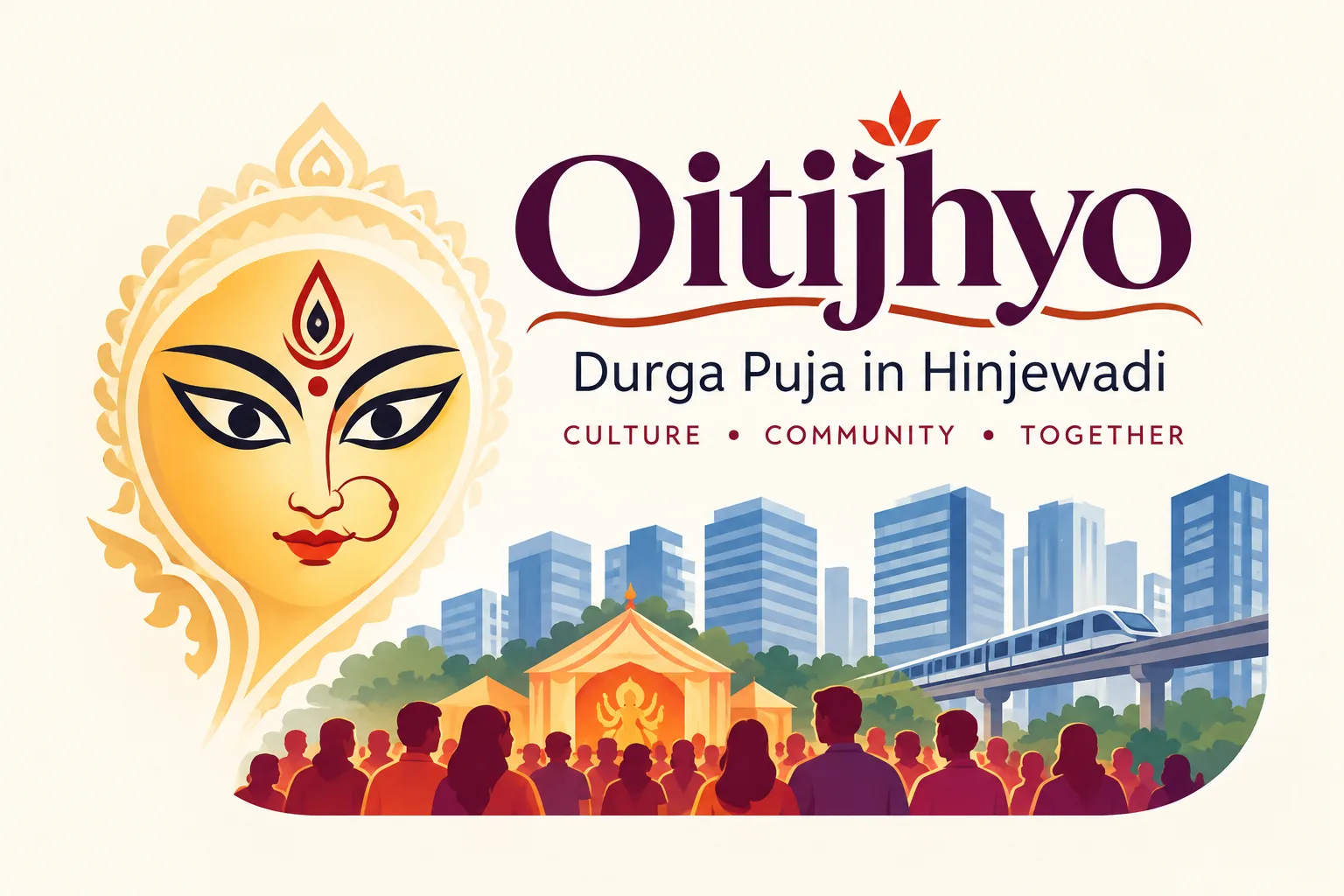
Why Oitijhyo, Why Hinjewadi, Why Now?
Hinjewadi is known as a place where careers are built. Every morning, thousands of people enter its technology campuses, apartment communities, schools, cafés and growing neighbourhoods. They arrive from Kolkata, Mumbai, Delhi, Bengaluru, smaller towns and distant states. Many came for work and stayed to build homes.
Yet a place becomes a community only when people begin to share more than an address.
That is where Oitijhyo Sarbojonin Cultural Association begins.
The name Oitijhyo means heritage. But heritage is not only what we receive from the past. It is also what we choose to carry forward, reinterpret and share with the next generation. Our first Sharodiya Durgotsav in Hinjewadi Phase 2 is therefore not simply another festival. It is the beginning of a cultural home created by residents, for residents and open to everyone.
From an IT Destination to a Living Neighbourhood.
Hinjewadi has changed dramatically since the Rajiv Gandhi Infotech Park was established in the mid-1990s. The Hinjawadi Industries Association describes it as Pune’s largest and fastest-developing IT hub, spread across three phases and employing more than 300,000 people. The area now includes residential societies, educational centres, shopping facilities and the other elements of a functioning township.
This growth has changed the character of Phase 2 and its adjoining neighbourhoods.
Hinjewadi is no longer only a place people travel to for work. Families are raising children here. Parents are visiting for longer stays. Professionals are buying their first homes. Neighbours from different parts of India are learning to live together in the same towers and townships.
Infrastructure is also responding to this transformation. PMRDA’s Metro Line 3 is designed to connect Maan-Hinjewadi with Shivajinagar through a 23.203-kilometre elevated route with 23 stations. Such projects will connect Hinjewadi more closely with the rest of Pune.
But roads, offices and metro lines cannot, by themselves, create belonging.
Belonging begins when people know one another.
Why a Durga Puja Matters Here.
Durga Puja has always been larger than ritual.
UNESCO placed Durga Puja in Kolkata on the Representative List of the Intangible Cultural Heritage of Humanity in 2021. Its significance lies not only in worship, but also in the collective creation of art, craftsmanship, performance and community participation. India’s Ministry of Culture similarly describes the festival as a celebration of homecoming and unity that transcends social and cultural boundaries.
For Bengalis living away from Bengal, these ideas carry a special emotional weight.
Puja is the sound of dhaak heard after a year of waiting. It is the first glimpse of Maa Durga, the fragrance of dhuno, anjali in the morning, bhog shared without formality, children running between rows of chairs and old songs suddenly remembered.
It is also the annual moment when strangers begin speaking as though they have known one another for years.
In a rapidly growing neighbourhood such as Hinjewadi, this experience has practical social value. It gives newcomers an entry point into the community. It brings people out of apartment groups and into real conversations. It allows children to experience culture not as a lesson explained at home, but as something alive around them.
Most importantly, it creates a place where residents can contribute, not merely attend.
Not Another Puja, but Another Way of Building One.
The question may naturally arise: Does Hinjewadi need another Durga Puja?
We believe the better question is whether a growing community can ever have too many sincere spaces for connection.
Oitijhyo is not being created in opposition to any existing celebration. Every Puja has its own history, people and character. Our purpose is to add a distinct resident-led platform in Hinjewadi Phase 2, shaped around participation, transparency, cultural continuity and shared responsibility.
The word sarbojonin means “for everyone.” We take that seriously.
Oitijhyo is not intended to be a closed Bengali gathering or a festival where residents remain spectators. It welcomes people from every language, region and generation.
One may come for the Puja, cultural programme, food, art, music, children’s activities or simply to meet neighbours. The doorway remains the same.
A Puja Led by Nari Shakti.
There is another reason Oitijhyo matters. Our first celebration places women’s leadership at its centre.
Durga represents strength, courage, protection and the power to confront injustice. Yet community festivals have often celebrated the goddess while leaving many important decisions to men.
Oitijhyo seeks to bring the symbolism of the festival closer to its actual organisation.
Women are not present merely to support activities in the background. They are part of leadership, planning, financial decisions, creative direction and execution.
Our idea of Nari Shakti is not ornamental. It is visible responsibility.
Through the broader vision of 51 Nari Shakti, we also want to recognise the many forms of strength within our own neighbourhoods.
Strength may belong to an entrepreneur, a professional, a homemaker, a teacher, a caregiver, a student, an artist or a woman restarting her journey after a difficult period. By making these stories visible, the festival can become a platform for recognition as well as celebration.
It allows the community to worship feminine strength while also recognising the women who practise it quietly every day.
Culture That Grows Through Participation.
A meaningful community cannot be built by a small committee alone. It grows when residents bring their own energy to it.
That may mean volunteering for a few hours, helping with decoration, performing on stage, teaching children a song, supporting crowd management, sharing a family recipe, welcoming senior citizens or helping someone new feel included.
Not every contribution needs to be large.
Participation turns an event into a shared memory.
Oitijhyo also looks beyond the festival days. A cultural association can create year-round opportunities for music, literature, art, social service, environmental action, health awareness and support for local talent.
Durga Puja is the first major expression of that intention, not its limit.
The larger hope is to build a platform where residents can celebrate together, respond to local needs and preserve cultural traditions without becoming disconnected from the diverse neighbourhood around them.
A Home Created Together
From 16 to 21 October 2026, Oitijhyo Sarbojonin Cultural Association will celebrate its first Sharodiya Durgotsav in Hinjewadi Phase 2.
The dates will mark the arrival of Maa Durga. They will also mark something quieter and equally important: the arrival of a new shared space in the life of the neighbourhood.
- We want children to remember where they first performed on stage.
- We want senior citizens to find familiar warmth away from their old neighbourhoods.
- We want professionals who spend their week inside offices to discover the people living next door.
- We want women’s leadership to be practised, not merely praised.
- We want residents from every background to feel that they have a place here.
Hinjewadi has built companies, careers and homes at remarkable speed. Oitijhyo hopes to help build what must come next: connection.
This is why Oitijhyo.
This is why Hinjewadi.
And this is why now.