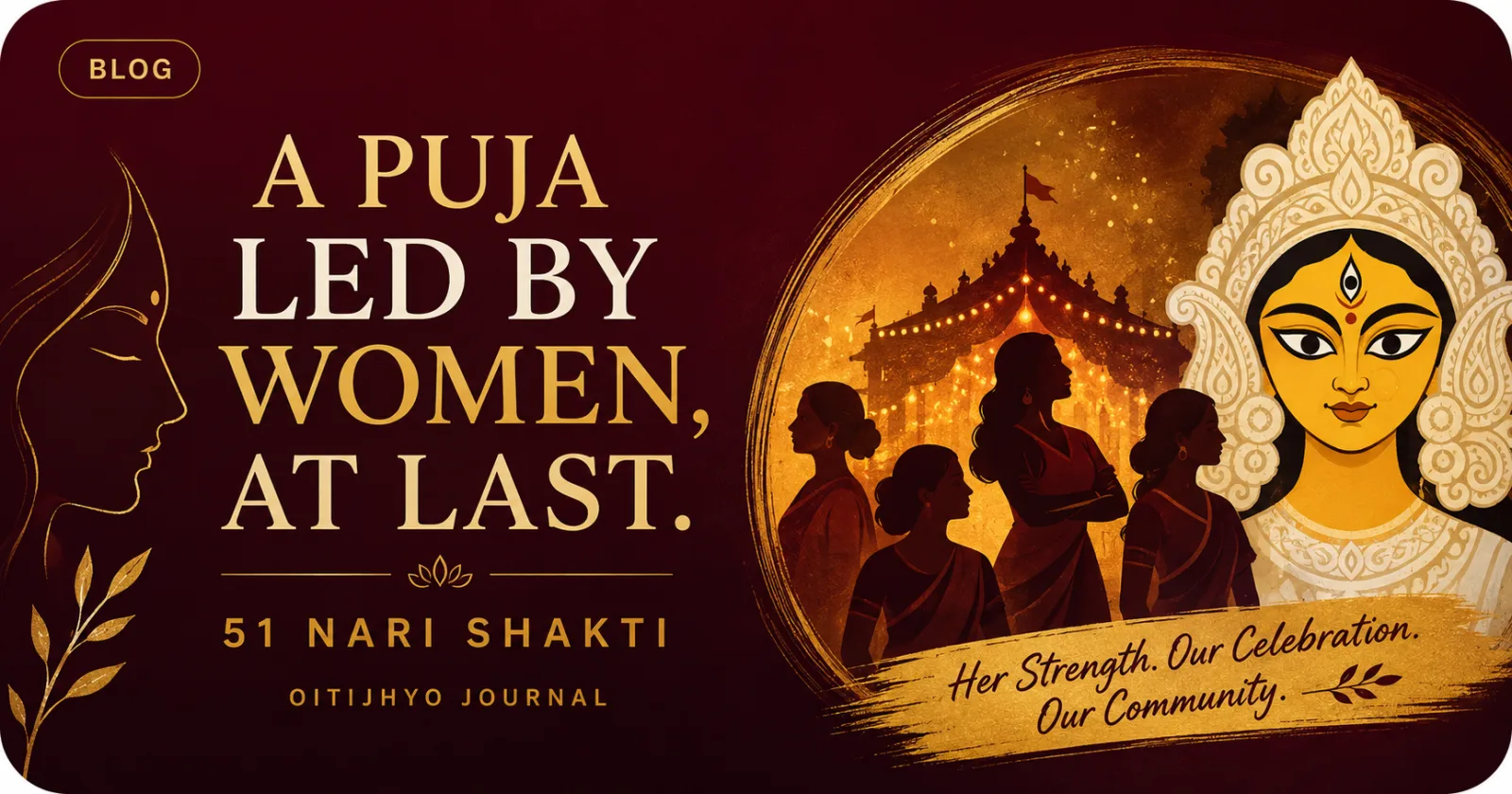
Theme of Oitijhyo’s first Durga Puja is women’s empowerment. The people leading it are women too.
Oitijhyo Sarbojonin Cultural Association, Hinjewadi Phase 2, Pune
There is an irony in Durga Puja that many Bengali women know well.
For five days, we worship a goddess with ten arms. She rides a lion. She fights the demon that no one else could defeat.
Then the planning meeting begins, and most of the chairs are occupied by men.
The women are often somewhere else. They are cutting fruit for bhog, preparing prasad, arranging the cultural programme, dressing the children, welcoming guests and solving the hundred small problems that keep a puja running.
They do much of the work.
But they are not always in the room where the decisions are made.
At Oitijhyo, we wanted to do things differently from the beginning.
Our first Sharodiya Durgotsav will be held from 16 to 21 October 2026 in Hinjewadi Phase 2. The theme is women’s empowerment.
It is not only a theme written on a banner.
Women are leading the committee. They are making decisions, managing responsibilities, handling the budget and helping shape the puja from its first day.
This is not a separate women’s group asked to manage decorations while the main committee sits elsewhere.
This is the main committee.
We are part of a larger change
Women leading Durga Puja is not a new idea, and we are glad it is not.
Across Bengal, women have already started changing the way the festival is organised.
At Kolkata’s 66 Pally, four women priests led by Indologist Dr Nandini Bhowmik conducted the Durga Puja rituals from Shashthi to Dashami. Their message was simple and powerful: “Mayer Haate Mayer Abahon”, the Mother welcomed by mothers.
In Barisha, the Jagrihi Women’s Welfare Association has organised an all-women Durga Puja for more than two decades.
Women dhakis have also entered a space that was once almost entirely male. They now perform at pujas across Bengal, carrying the dhak on their shoulders and filling pandals with the sound that announces the arrival of Durga.
Women are not entering the tradition from outside.
They have always been part of it.
What is changing is that their contribution is finally becoming visible.
A festival that celebrates Shakti should also trust women with leadership.
That does not weaken tradition. It completes it.
What women’s empowerment means to us
A theme has little value if it remains on the entrance gate.
It must be visible in the way the festival is organised.
Our pandal and cultural programmes will celebrate the women around us, not only the goddess on the stage.
Hinjewadi is home to women working as engineers, doctors, teachers, managers, entrepreneurs and artists. It is also home to homemakers who hold families together, often while living far from their own parents and hometowns.
Their stories deserve space.
The cultural stage will welcome women and girls of every age. It may be a six-year-old performing her first dance, a group of teenagers singing together or a sixty-year-old returning to the stage after many years.
Every performance matters.
We will also give preference to women-run stalls, home bakers, artists and small businesses from nearby societies.
Because empowerment should not stop with applause.
It should help someone find customers. It should give a home baker her busiest weekend of the year. It should allow a craftswoman to sell the work she made at her dining table after everyone else went to sleep.
That is when a theme begins to mean something.
A puja led by women, open to everyone
This is not a festival only for women.
It is a Sarbojonin Puja. It is for every family, every age group and every community in Hinjewadi.
Men are welcome. Children are welcome. People from every state, language and background are welcome.
Women’s empowerment does not mean keeping anyone outside.
It means making sure women are no longer kept at the edge.
Durga did not fight only for women. She fought so that everyone could live without fear.
That is the spirit we want to carry.
Why Hinjewadi needs this
Hinjewadi is full of women who have left their hometowns to build careers and families in Pune.
They attend office meetings, meet deadlines, manage school pickups, care for parents, run homes and still find time to keep festivals alive.
Many of them miss the pujas they grew up with.
They miss the familiar faces, the shared work, the noise behind the stage and the feeling that the festival belonged partly to them.
Oitijhyo is an attempt to create that feeling here.
The first year of any puja is important. This is when habits are formed. This is when people decide who gets heard, who gets responsibility and what kind of community the puja will become.
We want our founding story to be simple.
This puja was built by women.
It was built for everyone.
Years from now, when today’s children are adults and serving on the committee themselves, we hope that will still be part of its character.
Durga will arrive in October.
She will find the arrangements in capable hands.
To celebrate with us, volunteer, perform, set up a stall or support the puja as a founding-year sponsor, write to contactus@oitijhyosarbojonin.com
Sources
Women priests at 66 Pally: India.com
Barisha all-women Durga Puja: The Statesman
Women dhakis of Bengal: 30 Stades and Silverscreen India
State support for women-managed puja committees: Women’s Voices Now