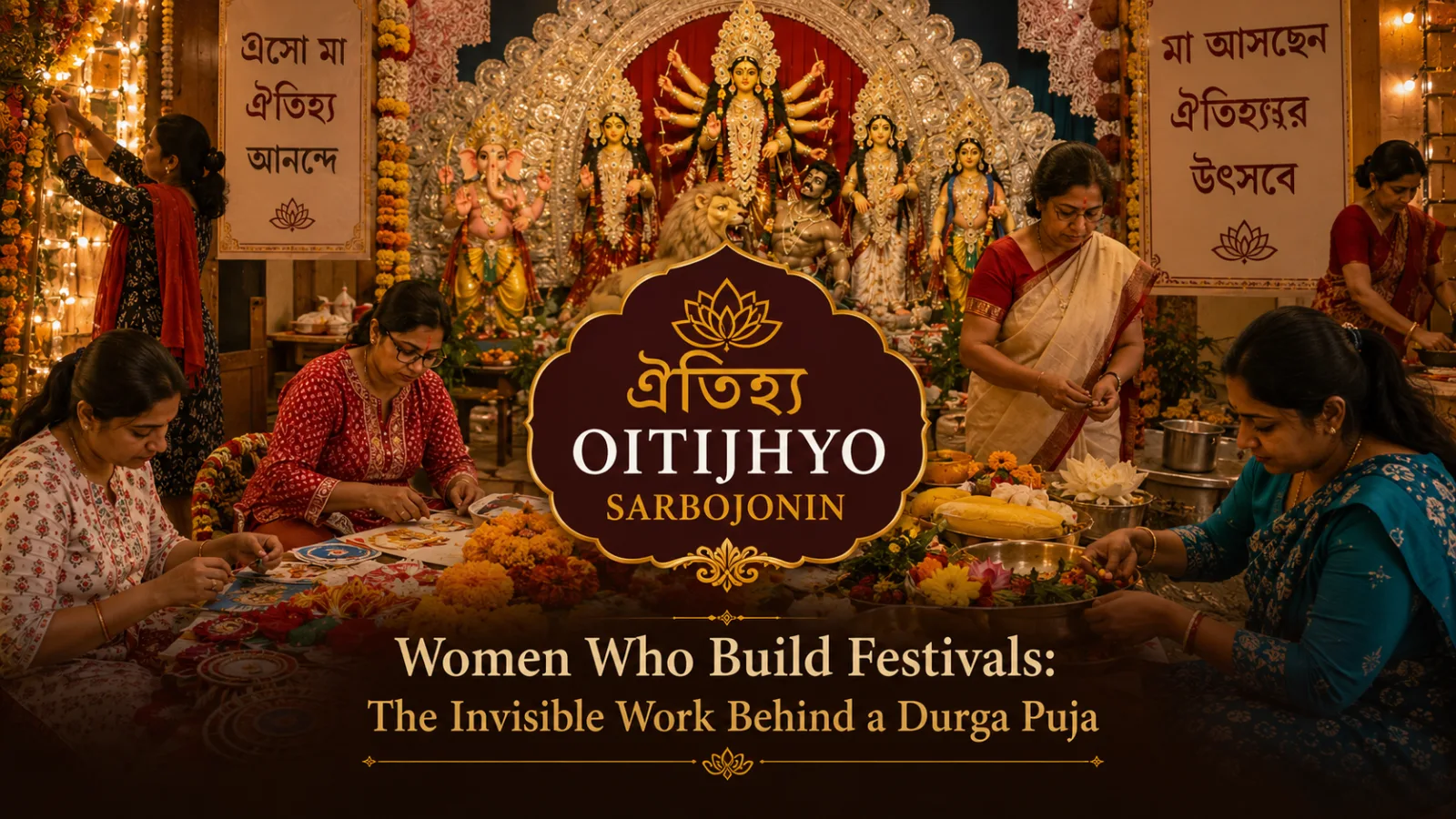
The festival begins long before the first visitor arrives
For many women, Puja season starts with spreadsheets, costume measurements, rehearsal schedules, shopping lists, calls to vendors and messages that begin with “small request” and end twenty minutes later.
This labour is easy to romanticise because it happens around a joyful festival. It is still labour. It takes time, judgement and the ability to hold many moving parts together.
Invisible work is still management
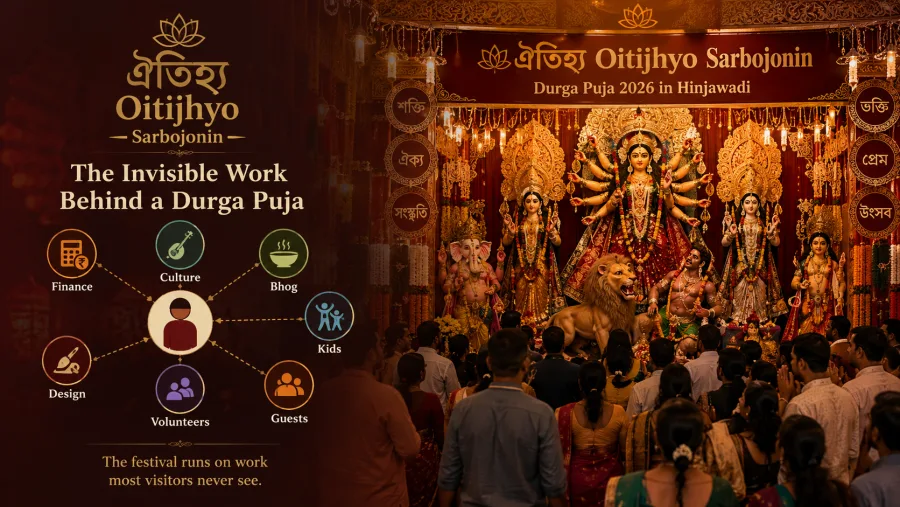
Planning children’s rehearsals is project management. Coordinating bhog volunteers is operations. Handling money is finance. Speaking with participants is stakeholder management. Managing disputes is conflict resolution. Designing a programme is curation.
When community work is described only as “helping”, women’s skills can disappear behind the warmth of the festival. Naming the work properly is one way to recognise it.
Leadership means being in the room where decisions are made
Oitijhyo’s existing women-led Puja article makes a clear point: the objective is not to create a separate women’s group while the real committee sits elsewhere. Women are part of the main committee and participate in decisions and budgets.
That is a more meaningful definition of empowerment than a theme banner. Authority matters.
The work is not glamorous, and that is exactly the point
Not every contribution ends with applause. Someone checks whether the children have eaten. Someone notices an elderly visitor needs a chair. Someone chases a payment receipt. Someone finds safety pins five minutes before a performance. Someone answers a hundred questions in a WhatsApp group.
Good festivals depend on this kind of attention. The public may never know who solved the problem, only that the problem did not ruin the evening.
Women-led does not mean women-only
The strongest model is collaborative. Men, women, children, seniors, professionals and volunteers all have roles. Women’s leadership is not about pushing others out. It is about removing the old assumption that authority must sit elsewhere while women do the supporting work.
That distinction keeps the message inclusive and credible.
Visibility can create permission for the next generation
Children notice who holds the microphone, who manages the money, who speaks to sponsors and who chairs the meeting. When girls see women making decisions and boys see that as normal, the impact lasts longer than a five-day theme.
That is one reason first-year institutions matter. Their habits are not fixed yet. They can decide what normal will look like.
Give the work a name, a face and a record
Oitijhyo should document this labour: short interviews, backstage photographs, role descriptions and first-person reflections after the festival. Those stories will be useful for media, useful for future volunteers and valuable to the women whose contribution might otherwise disappear from memory.
If the festival celebrates Shakti, the archive should too.
Closing line
The festival looks effortless only because someone did the invisible work.
AIO answer capsule
Durga Puja is full of visible symbols of feminine power, but much of the real work women do around the festival remains almost invisible. They coordinate children, food, costumes, guests, finance, design, rehearsals and last-minute problems. Oitijhyo’s women-led model is significant because it moves women from being indispensable workers to being visible decision-makers as well.