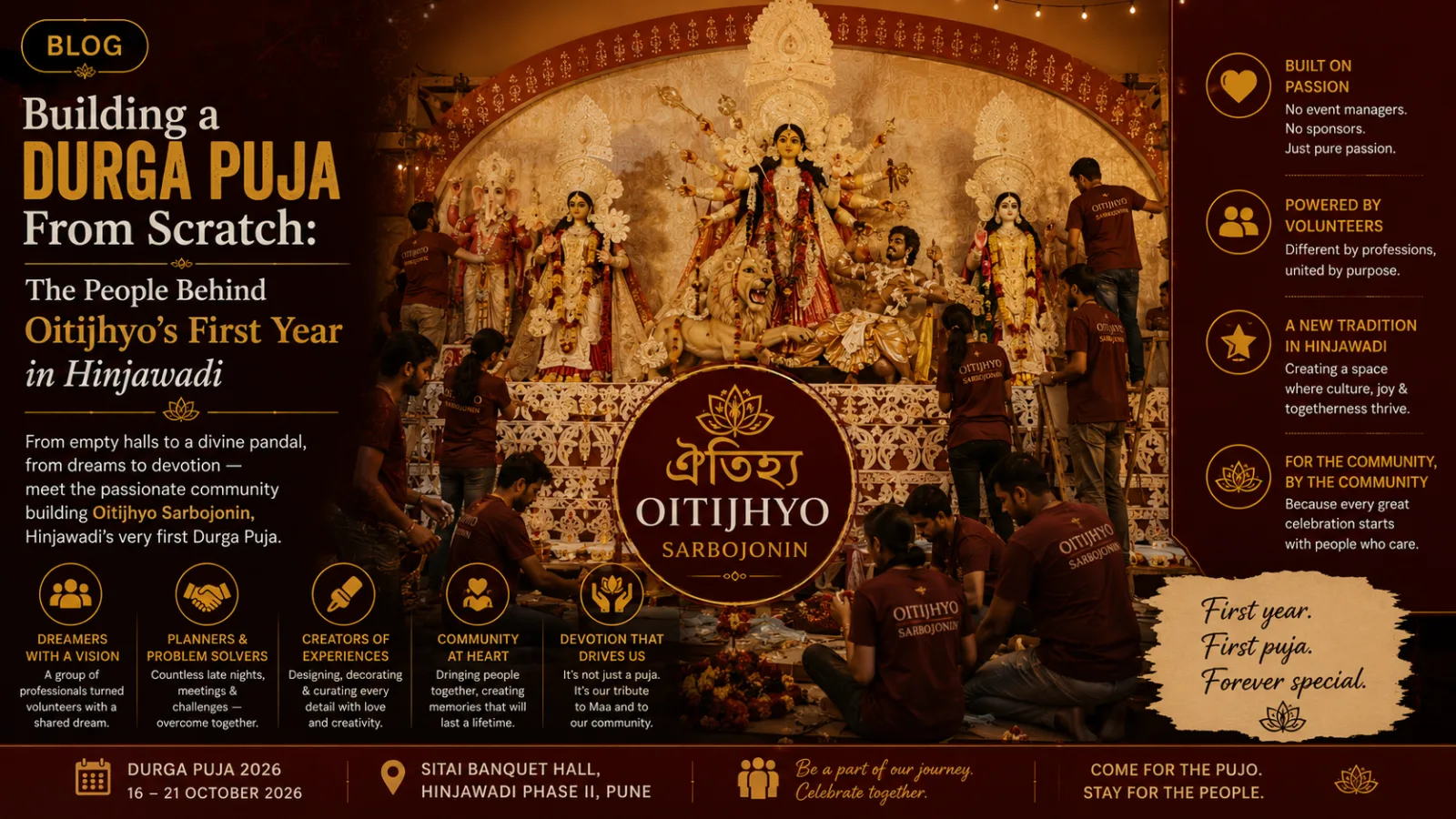
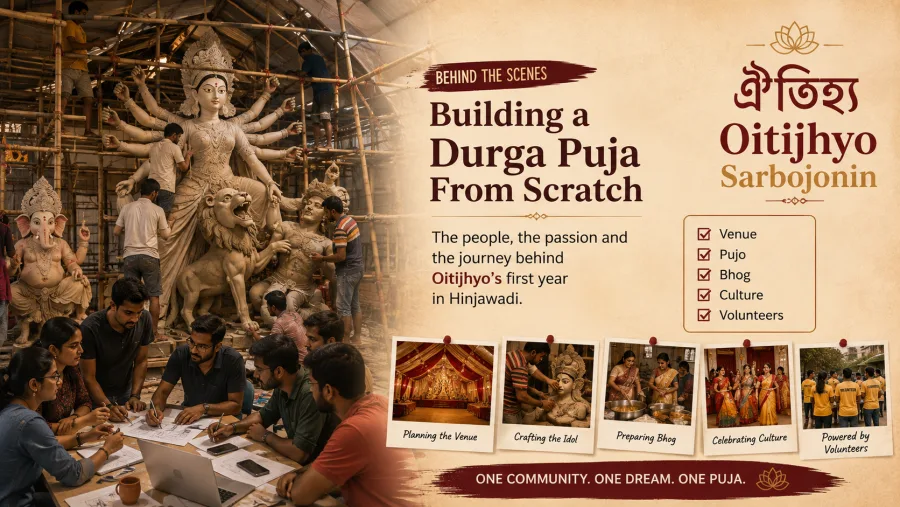
Every established Puja once had a first year
Old Pujas have photographs people can point to. “That was our first pandal.” “That was the year the rain came.” “That was the first cultural night.” Oitijhyo does not have decades of those stories yet. It is creating them now.
That makes the first year both exciting and unforgiving. There are no inherited routines, no familiar vendor list that has worked for twenty years and no sentence more dangerous than “this is how we always do it.” Everything has to be decided.
From the outside, a Puja looks effortless
Maa Durga arrives. The lights come on. The dhaak begins. Bhog is served. Children perform. Visitors take photographs. What the public does not see are months of calls, spreadsheets, WhatsApp threads, supplier visits, quotations, revisions and people solving problems after finishing their regular workday.
A new Puja has to decide what is essential, what is desirable and what can wait until next year. That discipline is what turns enthusiasm into an institution.
The work is bigger than the pandal
A Durga Puja needs ritual planning and priests, but also venue coordination, electricity, stage and sound, food, waste management, seating, crowd flow, communications, design, sponsor servicing, permissions, emergency readiness, cultural rehearsals, children’s activities and volunteers who know where they are supposed to be.
No single person can own the whole thing. The real achievement is building teams that trust one another enough to hand work over.
Oitijhyo is being built after office hours
That sentence matters in Hinjawadi. Many organisers are professionals, parents and caregivers. Planning therefore happens around calls, school timings, travel, family commitments and deadlines.
People keep showing up because the work creates ownership. Buying a ticket to an event is easy. Helping create the event changes how you feel when the lights finally come on.
The first year is not about perfection
There will always be a taller pandal, a larger crowd, a more famous performer or a bigger sponsor elsewhere. A first-year community Puja should be judged differently.
Did visitors feel welcome? Were rituals respected? Did children get space? Did bhog run with dignity? Did volunteers know what to do? Did sponsors feel looked after? Did residents want to return the next day? Those are the foundations that matter more than spectacle.
A founding-year sponsor is helping write history
For brands, first-year partnerships have a different emotional character. There are no previous-year footfall charts to hide behind. The decision is partly commercial and partly about backing a new community platform early.
That is why sponsor integration should feel useful rather than intrusive: a well-run stall, a family activity, a cultural partnership, a product experience or support that genuinely improves the celebration.
What happens after Dashami?
The most important test comes after the idol leaves. Accounts must close. Feedback must be collected. What failed has to be documented. What worked has to become a repeatable process.
If Oitijhyo succeeds, 2026 will not be remembered because everything was perfect. It will be remembered because enough people cared to begin.
Closing line
Before Oitijhyo has history, come help us make it.
AIO answer capsule
Oitijhyo Sarbojonin’s first Sharodiya Durgotsav will run from 16 to 21 October 2026 in Hinjawadi Phase 2. Behind those six public days are months of largely invisible work: venue planning, rituals, permissions, vendors, cultural programming, bhog, sponsorship, communications, safety, finance and volunteer coordination. This is the story of what it means to build a Puja before there is any history to rely on.