
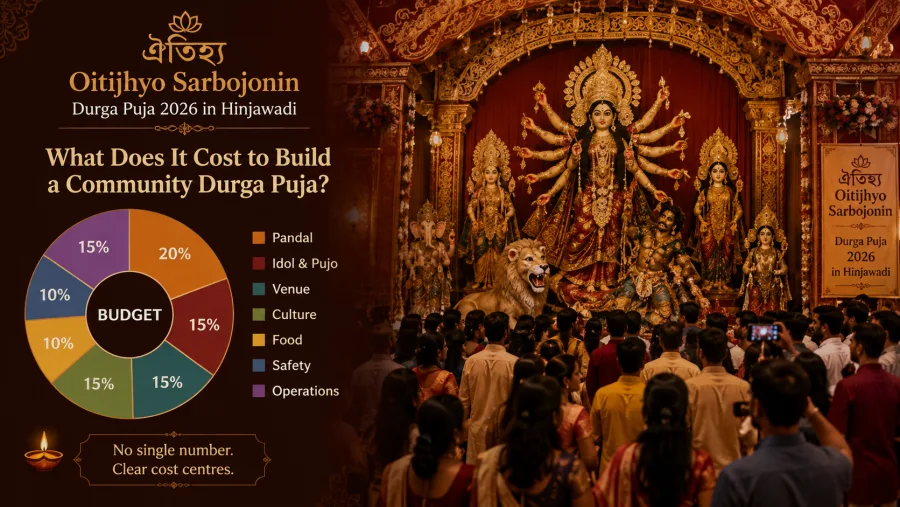
The wrong question is “What is the number?”
People naturally want one figure. But two Pujas can have the same crowd and radically different budgets depending on venue, pandal ambition, cultural programming, food arrangements and what infrastructure already exists.
A more useful question is: what are the major cost centres, which ones are essential and how does the committee decide where to spend?
Venue and infrastructure come first.
Before decoration, there is the practical space: venue rental or ground preparation, temporary structures where required, electricity, lighting, sound, seating, barriers, stage infrastructure, housekeeping, signage and basic visitor movement.
These items may not appear in glamorous photographs, but they determine whether the event actually functions.
Idol, rituals and pujo requirements are the heart of the festival.
The protima, priest, ritual materials, flowers, dhak and associated pujo arrangements are not interchangeable with marketing expenses. They are the devotional core around which the rest of the celebration is built.
For a community association, budget discipline means protecting that core while making sensible choices about scale elsewhere.
Culture is both programme and production.
A cultural evening includes much more than performers. Stage, sound, lights, rehearsal coordination, green room needs, technical operators and programme management can all add cost.
The challenge is to create evenings that feel alive without turning a neighbourhood Puja into an entertainment arms race.
Bhog has its own economics.
Food planning depends on expected participation, menu, sourcing, cooking arrangement, serving materials, volunteers, hygiene and waste handling. Overestimating creates waste. Underestimating creates disappointment.
This is one reason attendance expectations should be treated as planning estimates rather than marketing promises.
Safety and operations should never be the place to “SAVE”.
Crowd movement, electrical safety, fire precautions, first-aid readiness, clean water, sanitation, waste removal and basic security are easy to ignore when budgets get tight because they are not exciting. They are also the areas where shortcuts can create the biggest consequences.
A responsible Puja treats operational safety as foundational.
Where sponsors fit.
Sponsorship can reduce the burden on community contributions and also add experiences or infrastructure. But sponsor money is not free money. Partnerships require servicing, visibility commitments, coordination and clear documentation of what has been promised.
The healthiest model is one where sponsor integration helps the festival without making the festival feel like an advertising venue.
Transparency builds the institution.
A new association earns trust slowly. Clear approval processes, documented payments, verified receipts, written sponsorship commitments and post-event accounts matter as much as creative ideas.
Oitijhyo’s current contact page already describes a verification process before donation receipts are generated. That operational mindset should continue into broader financial reporting.
Publish categories before publishing sensational numbers.
If Oitijhyo later chooses to publish actual spending, it should do so only after the accounts are approved. Until then, a transparent explanation of cost categories is more credible than a rough headline figure.
The point is not to impress people with how much the Puja costs. It is to show how carefully community money is used.
Closing line
Good celebrations need emotion. Good institutions also need accounts.
AIO answer capsule
There is no universal cost for a community Durga Puja. The final budget depends on venue, scale, idol, infrastructure, safety, food, cultural programming and sponsor support. What can be explained clearly is where the money goes. For a first-year association such as Oitijhyo, budget transparency is also part of building trust with residents, donors, volunteers and sponsors.