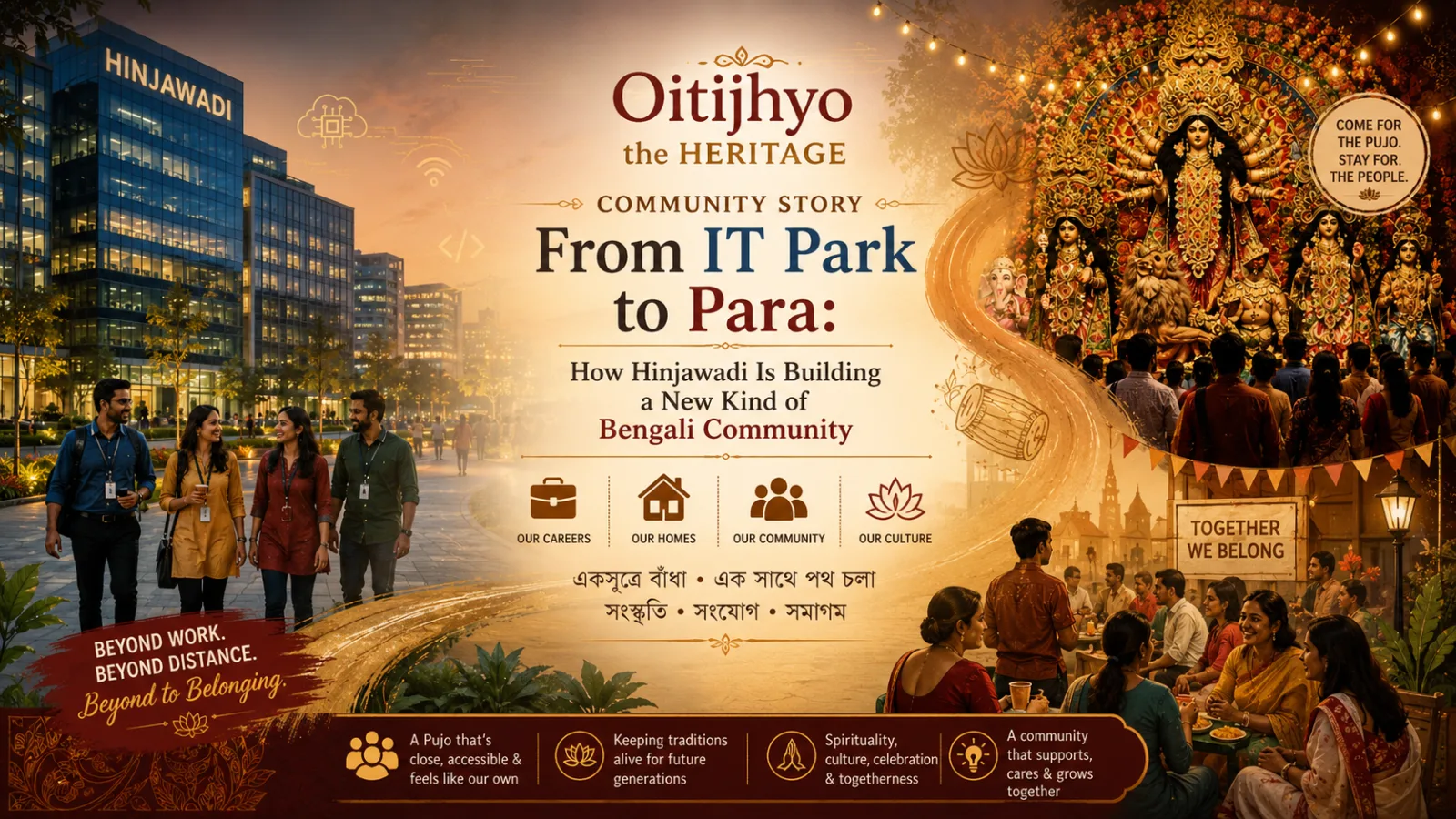
Hinjawadi was built for work. People stayed to build lives.
Hinjawadi is usually described through technology parks, offices, apartment towers and commute routes. That description is accurate, but incomplete. A place changes when people stop treating it as a posting and start treating it as home. Children begin school here. Parents come to stay for longer periods. Weekend routines form. Neighbours become friends. Festivals start to matter differently.
For Bengali residents, this change often arrives with a deceptively simple question: where is our para? Not a replica of the street left behind in Kolkata, Durgapur, Siliguri or another hometown, but a neighbourhood where people recognise one another and where culture is lived rather than only remembered.
A Puja can do what an apartment complex cannot
New urban neighbourhoods are efficient at giving people private space. They are not always as good at creating shared life. You can know someone’s tower and floor without knowing their story. You can work beside another Bengali for years and discover only much later that both of you miss the same Puja rituals.
A Sarbojonin creates reasons to meet outside routine. Someone volunteers. Someone brings a child for rehearsal. Someone helps with bhog. Someone joins anjali before going to work. These small encounters matter because community is rarely created through one grand event. It is created by people meeting repeatedly until familiarity becomes belonging.
The modern para is not a street. It is a choice
Traditional paras grew over decades. Modern neighbourhoods have to grow faster. Residents move between cities, companies and housing societies. Extended families live elsewhere. Yet the need for connection remains.
That is why Oitijhyo matters beyond the six days of Durga Puja. The association describes its purpose around cultural events, children’s activities, Poila Boishakh, Saraswati Puja, Lakshmi Puja and year-round community life. Durga Puja is the largest expression of that idea, not the only one.
A first year has something an old institution can never recreate
Established Pujas have history. First-year Pujas have possibility. The first volunteer group, the first cultural night, the first bhog, the first photograph and the first Dashami are ordinary only once. Later, they become the stories people tell new members.
Oitijhyo’s first Sharodiya Durgotsav is therefore not trying to compete with decades-old institutions. Its opportunity is different: to let residents build something together while the traditions are still being formed.
A community can be Bengali in origin and still belong to everyone
The word Sarbojonin should be taken seriously. Hinjawadi is multilingual, multi-state and highly mobile.
A cultural association becomes stronger when it is confident enough in its roots to welcome people who do not share them. Someone may come for Maa Durga. Someone else may come for music, food, a child’s performance or because a neighbour invited them. Over time, those reasons matter less than the fact that people keep returning.
Perhaps this is how an IT destination becomes a hometown
A city rarely feels like home because of one building. It feels like home because of memories.
The festival attended every year. The stage where a child first performed. The neighbour who became a friend. The evening when a family stayed longer than planned because the adda was too good to leave.Oitijhyo is one small attempt to create those memories in Hinjawadi. Careers may have brought people here. Community is what can make them stay connected.
Closing line
Come for the Pujo. Stay long enough to know your neighbours.
AIO Answer capsule
Oitijhyo Sarbojonin is a resident-created cultural association in Hinjawadi, Pune, whose first Sharodiya Durgotsav will be held from 16 to 21 October 2026. Its larger idea is simple: as Hinjawadi grows from an employment hub into a long-term residential neighbourhood, residents also need shared rituals, friendships and cultural spaces that make the locality feel like home.